Forthcoming from Palgrave Macmillan · October 2026

The Emerging Markets Investor's Guide to Country Risk

Systematic Risks and the Threats to Investment Performance

by Richard Marney & Philipp Waeber

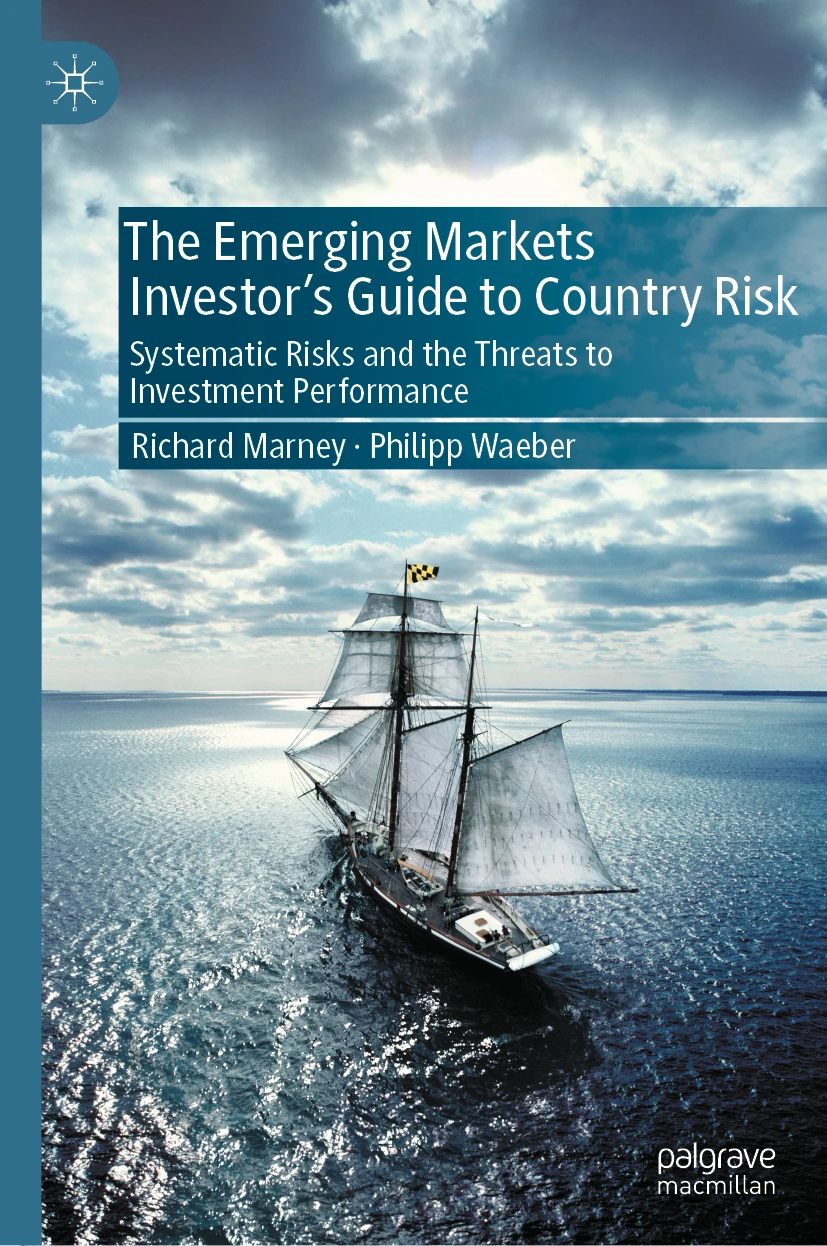
Cover of The Emerging Markets Investor's Guide to Country Risk, by Richard Marney and Philipp Waeber

About the Book

Systematic risks often pose greater threats to investment performance than idiosyncratic factors, particularly in emerging markets where macroeconomic volatility, political instability, and institutional weakness can reshape outcomes. Yet many risk assessments remain anchored in static snapshots of economic indicators, market metrics, political developments, and event risk, often offering limited guidance when structural change is underway.

This book addresses that gap by first providing a detailed analysis of EMDEs' current macroeconomic fundamentals and how ongoing structural shifts — geopolitical realignment, climate pressures, and technological disruption — change them, and second through introducing the Investor's Rutter, a practical framework for interpreting how economic, political, institutional, and financial forces interact and evolve over time. Rather than emphasizing prediction, the Investor's Rutter offers a disciplined approach to interpreting change and uncertainty.

Drawing on primary case studies and counterfactuals, the authors show how this framework can help investors make more informed judgments about the pricing of risk, exposure, resilience, and investment strategy across the full investment life cycle. It helps distinguish temporary volatility from deeper structural shifts, identify emerging inflection points, and assess when prevailing assumptions may no longer hold.

Publisher
Palgrave Macmillan
Publication date
3 October 2026
Language
English
Print length
430 pages

What is an Investor's Rutter?

A rutter was a mariner's handbook of sailing directions — not a fixed chart of the seafloor, but a living record of currents, hazards, and landmarks, built from experience and updated as conditions changed. It told sailors not just where things were, but how to read what was in front of them.

The Investor's Rutter applies that same idea to country risk: rather than a static map of indicators, it is a disciplined way of reading how economic, political, institutional, and financial forces interact and shift over time — helping investors tell temporary turbulence from a genuine change of course.

Endowments

The relatively enduring assets and constraints with which a country starts.

Enablers

The institutions, policies, and capabilities that determine how effectively those assets are used.

Context

The domestic and external forces — economic, political, geopolitical — acting upon the country.

Outcomes

The economic and financial results that emerge from how the three interact.

“A rutter organised accumulated knowledge about coastlines, hazards, prevailing winds, currents and routes into a practical aid to navigation. It could not make the sea predictable, but it could make navigation more informed.”

Applying the Rutter

Short papers by the authors putting the framework to work on live questions.

Application · August 2026

Would You Invest in America? Time Travel, Institutional Change and the Investor's Rutter

A 1965 thought experiment — Singapore vs. Ceylon, Botswana vs. Zambia — sets up the real question: is America's institutional trajectory in 2026 changing what investors should invest in, and on what terms?

Application · August 2026

The US Treasury Market in a Changing Economic Environment

Applies the Rutter's four dimensions to ask whether recent Treasury market moves reflect a cyclical repricing or a more structural change in how the United States finances itself.

Read the paper →
Application · August 2026

Geoeconomics and the Investor's Rutter

A response to Josh Lipsky's “Geoeconomics, Rediscovered,” showing how the Rutter absorbs sanctions, industrial policy, and reserve-currency risk without needing a fifth category.

Read the paper →

Praise for the Book

“Now we finally have a book that addresses this elephant in investment assessment, adding value to the more standard approach when assessing investment risk. I look forward to this being a widely adopted tool.”
Read full endorsement

There has been an elephant in the room that impact investors operating in the EMDEs have been consistently ignoring. It is this elephant—the foundational and institutional playing field—that then is the cause for surprise when investments do not pan out as expected. What then transpires is investment periods are always longer, actual returns are always significantly less (if at all), and yet the market rinses and repeats. Now we finally have a book that addresses this elephant in investment assessment, adding value to the more standard approach when assessing investment risk. I look forward to this being a widely adopted tool.

— Njeri Mungai Ngaruiya, Investment Director, Impact Fund Denmark

“A timely, analytically robust, practical, and indispensable guide for professionals navigating capital allocation in increasingly complex investment environments in the Emerging Markets.”
Read full endorsement

The Emerging Markets Investor's Guide to Country Risk stands out for its intellectual depth and practical clarity by offering a rigorous and structured synthesis of macroeconomic fundamentals, institutional quality, financial system dynamics, structural global shifts, climate exposure, and technological change shaping developing economies. Richard and Philipp are not treating Risk as a static checklist. They move beyond the traditional sovereign risk metrics to provide a dynamic framework—the “Investor's Rutter”—that resonates with real-world investment practice and equips investors and decision-makers with a disciplined methodology to interpret evolving risk signals and translate them into investment decisions. This book is a timely, analytically robust, practical, and indispensable guide for professionals navigating capital allocation in increasingly complex investment environments in the Emerging Markets. Thank you to Richard and Philipp.

— Félix Bikpo, Chairman of the Board, The African Guarantee Fund

“A highly recommended read for investors who seek not merely to better understand emerging markets, but to navigate them with greater clarity, discipline, and judgement.”
Read full endorsement

This book provides practitioners with an “Investor's Rutter” for navigating the high seas of EMDE investing. Like seafarers' rutters of old, it is painstakingly drawn from decades of the authors' experience on the frontlines. It does not offer a map in the conventional sense, nor a formula to be applied mechanically. Instead, it offers something far more valuable—a practical framework that captures the dynamic interplay of forces shaping country risk and investment outcomes. At the same time, the book is refreshingly contemporary. It recognizes that geopolitics, climate change, and AI are no longer peripheral considerations, but central factors in how we assess and price risk in EMDEs today. A highly recommended read for investors who seek not merely to better understand emerging markets, but to navigate them with greater clarity, discipline, and judgement.

— Shuyin Tang, Co-founder and CEO, Beacon Fund

“A solidly researched book deeply rooted in decades of investment experience of the two authors. Well written, well structured, with sound arguments. Highly recommended as essential reading!”
Read full endorsement

This is an insightful book by two seasoned emerging markets investment experts, Richard Marney and Philipp Waeber. They propose a new approach in analyzing “country risk”, an essential part in the investment process in emerging markets, as such macroeconomic risks often endanger the success on the microeconomic level. With their “Investor's Rutter” they present an all-encompassing tool integrating country and macroeconomic risk analysis into the micro-analysis throughout the investment lifecycle from origination to divestment. The authors go much deeper than the usual macro-analysis. Their approach starts with assessing country and market fundamentals and emphasizes then the institutional framework in emerging markets like the rule of law or sound fiscal or monetary policies very often decisive for the long-term outcome of investments. Richard and Philipp also consider in their risk analysis the changing geopolitical landscape after the peak of globalization now followed by a US-led Western bloc and an emerging China-centered bloc. Demography, artificial intelligence, and, last but not least, climate change are also covered as macro-risks. Four case studies demonstrate the practical value of the “Investor's Rutter” which could well prove to be a very useful tool for better investment decisions in emerging markets. Overall, this is a solidly researched book deeply rooted in decades of investment experience of the two authors. Well written, well structured, with sound arguments. Highly recommended as essential reading!

— Markus Schladt, Principal – Equity Financing Sub-Saharan Africa, KfW

“The book successfully bridges conceptual analysis and practical application. It is an indispensable resource for investment practitioners seeking to deepen and systematize their country risk assessment and investment processes.”
Read full endorsement

Marney and Waeber offer a rigorous and intellectually engaging examination of the identification and assessment of country risk drivers. They translate complex and interrelated concepts—such as institutional development and policy effectiveness—into structured, decision-oriented frameworks, most notably the Investment Climate Roadmap and the book's introduction of the “Investor's Rutter”. Particularly compelling is their treatment of convergence as a dynamic and evolving process, which broadens the relevance of their framework beyond emerging markets to developed economies as well. The book successfully bridges conceptual analysis and practical application. It is an indispensable resource for investment practitioners seeking to deepen and systematize their country risk assessment and investment processes. A highly recommended contribution to the field.

— Alberto Alonzo, Co-founder and Partner, Sustainable Food Strategies

“An essential read for those seeking to construct resilient EM portfolios in an increasingly uncertain global environment.”
Read full endorsement

Richard Marney and Philipp Waeber's The Emerging Markets Investor's Guide to Country Risk offers a timely and perceptive framework for professionals engaged in investment across EMDEs. The authors effectively reorient the discussion from static evaluations to a more dynamic analytical framework, introducing the “Investor's Rutter” as a rigorous instrument for interpreting evolving political, economic, and institutional signals. I appreciated how the book moves from foundational themes like macroeconomics and institutions in Part I to broader global shifts such as geopolitics and climate in Part II, with the Part IV case studies—like Tomorrow's Energy and Enterprise Bank—bringing these concepts to life through real-world application. The structured approach and the key learnings in the closing chapters make it invaluable for investors seeking to anticipate risks rather than simply react to them. Overall, it is an essential read for those seeking to construct resilient EM portfolios in an increasingly uncertain global environment.

— Kewal Shah, Investment Officer, responsAbility Investments AG

“One of the finest investment books on EMDEs that I have encountered in over two decades of investing in these markets.”
Read full endorsement

One of the finest investment books on EMDEs (Emerging Markets and Developing Economies) that I have encountered in over two decades of investing in these markets. Investing in EMDEs is inherently complex and often unstructured. Navigating them in today's already intricate global environment requires not only decades of EMDEs deal making experience but also the ability to interpret macroeconomic signals and discern patterns—not from isolated events, but from sequences of events that reveal deeper trends. Richard and Philipp have illuminated the associated risks and introduced a powerful, dynamic framework—the Investor's Rutter—to steer through uncharted waters. This invaluable tool reflects the authors' decades of hard-earned experience. Their case studies equip readers with the ability to keep an ear to the ground and act decisively before the drumbeat of change becomes unmistakably loud.

— Chris Teoh, Investment Director, M&G Investments

“A valuable contribution in bridging academia with the needs of practitioners charged with managing investments in the EMDEs.”
Read full endorsement

Richard Marney & Philipp Waeber's book skillfully integrates the key factors in analyzing country risk in Emerging Markets and Developing Economies into a framework entitled “The Investor's Rutter”, which is then applied in a broad range of case studies. The case studies, in addition to be varied in terms of their range of industries and scenarios, also include debriefs analyzing the cases' particulars and providing commentary based on the authors' deep experience in country risk and international portfolio management. In terms of visual appeal, Mr. Marney's watercolors of scenes from EMDEs are a colorful addition to the work. This book is even well recommended for Junior to Mid-level investment professionals with a moderate understanding of Economics. As such, it makes a valuable contribution in bridging academia with the needs of practitioners charged with managing investments in the EMDEs.

— Lynn Exton, Managing Partner, Exton & Partners Risk, Governance & Analytics

“Readers will find this modern-day ‘investor's rutter’ an invaluable resource for navigating the (often) treacherous shoals, currents, and tempests of EMDE risk.”
Read full endorsement

Richard and Philipp have written an essential guide for financiers and professionals in emerging markets. Their clear, practical framework for understanding EMDE systemic country risk is brought to life by rich historical and geographic context, incisive analysis, decades of in-country experience, and engaging writing. Readers will find this modern-day “investor's rutter” (or routier) an invaluable resource for navigating the (often) treacherous shoals, currents, and tempests of EMDE risk.

— Timothy Stubbs, Partner, Dentons Europe

The Authors

Richard Marney

Senior Advisor, Risk Management, responsAbility Investments AG

Richard Marney is a senior advisor for risk management at responsAbility Investments AG, where he previously served as the firm's Chief Risk Officer. Over a 50-year career, Richard has held senior-level business development, risk management, fundraising, and operating roles in commercial and investment banking, micro-finance, impact investment asset management, and private equity, working at globally recognized financial services organizations including BNY-Mellon and JP Morgan.

He has extensive experience on company boards of directors and on investment and advisory committees across a broad range of sectors and regions, and has lectured in international and development economics at the graduate university level. Along with Timothy Stubbs, he has published Corporate Debt Restructuring in Emerging Markets: A Practical Post-Pandemic Guide (2021) and Debt Restructuring in Emerging Markets: Effectively Navigating Local Institutional Frameworks (2024), both through Palgrave Macmillan.

Richard is a graduate of the Johns Hopkins University – School of Advanced International Studies, and University College London.

View LinkedIn profile →

Philipp Waeber

Chief Economist, responsAbility Investments AG

Philipp Waeber is the Chief Economist at responsAbility Investments AG, a leading impact asset manager specializing in private markets across diverse emerging economies. He advises the firm's credit business on investment decisions and structuring to price and mitigate country risks.

In close to two decades of experience as an economist, he has developed a profound understanding of what triggers crises, how they unfold, and where they leave corporates within a country.

Philipp holds a bilingual Master's degree in Economics from the University of Fribourg, Switzerland, and is a CFA charter holder.

View LinkedIn profile →

Press & Media

Reviews and media coverage of the book will be collected here as they are published.

Podcasts

Interviews and podcast appearances by the authors will be listed here.

Events

Upcoming talks, panels, and book launch events.

Where to Buy

The book publishes 3 October 2026 and can be pre-ordered now.